
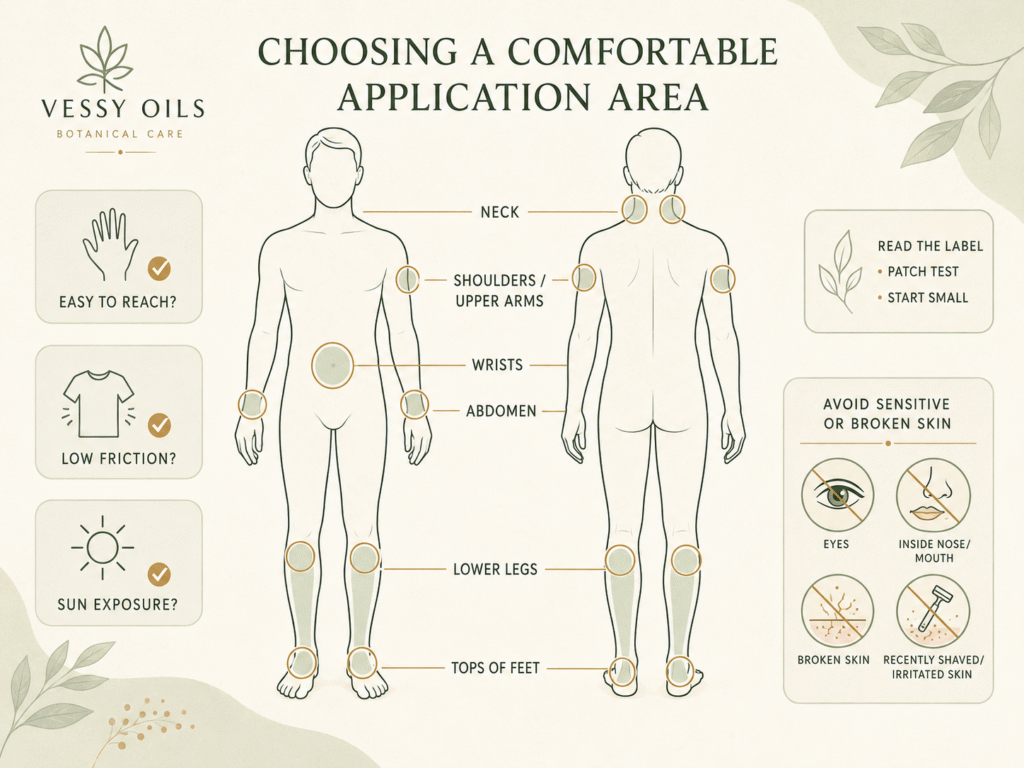
An essential oil roll-on is easy to use, but choosing where to apply it is not always obvious. Wrists? Neck? Feet? Stomach? The internet offers plenty of confident answers, often without explaining why one location might suit your routine better than another.
The truth is simpler: there is no single “best” application point for everyone.
A useful spot should be easy to reach, comfortable on your skin, unlikely to rub against clothing, and appropriate for the product’s directions. This guide offers a practical body map for choosing that spot without turning a small daily ritual into a complicated project.
Before You Choose a Spot, Read the Label
Some essential oil roll-ons are already blended with a carrier oil and intended for topical use. Others may be more concentrated. Never assume that every bottle can be applied in the same way.
Check the label for:
- Whether the product is intended for topical use
- Recommended application areas
- Dilution or usage instructions
- Warnings about children, pregnancy or sun exposure
- A complete ingredient list
“Natural” does not automatically mean irritation-free. Plant-derived fragrance ingredients may still cause irritation or allergic reactions, and certain citrus oils can increase sensitivity to sunlight. Always follow the directions supplied with the specific product.
If you are trying a new topical blend, begin with this guide to patch testing essential oils before using it over a larger area.
The Three-Question Placement Test
Rather than memorizing a list of pulse points, ask three quick questions.
1. Can I Easily Reach and Monitor This Area?
A first application should go somewhere you can see and wash easily, such as the inner forearm. This makes it simpler to notice redness, itching or discomfort.
2. Will Clothing Constantly Rub Against It?
Waistbands, tight collars, watch straps and bra lines create friction. Even a product that normally feels comfortable may become irritating when trapped beneath tight fabric.
3. Will the Area Receive Direct Sunlight?
If the blend contains a photosensitizing citrus oil, exposed skin may not be the right choice before going outside. Read the product warning and choose a covered location when necessary.
These three questions are often more useful than chasing the “perfect” pulse point.
Application Area 1: The Inner Wrists
The wrists are popular because they are accessible and allow you to notice the aroma without applying the product near your face.
Apply a light pass to one wrist. Instead of vigorously rubbing both wrists together, gently touch them together if you want to distribute the oil. Hard rubbing is unnecessary and may add friction to sensitive skin.
The wrists may not be ideal when you:
- Wash your hands frequently
- Wear a tight watch or bracelet
- Have irritated or recently shaved skin
- Spend time outdoors with a photosensitizing blend
Think of the wrist as a convenient scent point, not a location with guaranteed therapeutic powers.
Application Area 2: The Sides of the Neck
The sides or back of the neck can work well for a personal aromatic ritual because the scent remains relatively close without being placed directly beneath the nose.
Use a small amount and avoid the front of the throat. Do not apply immediately before putting on a tight collar, scarf or necklace. Friction and trapped heat can make the area feel more sensitive.
If you want to use a botanical blend as part of an evening routine, pair the application with a consistent cue: lower the lights, put away your phone and take a few slow breaths. The routine matters as much as the location.
For a more complete evening sequence, see our gentle essential oil routine for a stuffy nose at night. Never place essential oil inside the nostrils.
Application Area 3: Shoulders and Upper Arms
The shoulders and upper arms are practical locations for massage-oriented body oils because they provide a broad, muscular area away from the eyes and mouth.
A roll-on can be applied in several short lines and then spread with clean hands, provided the product label permits massage application. Use gentle pressure rather than trying to forcefully “work out” discomfort.
Avoid rolling repeatedly over the same area. More product does not necessarily create a better experience. A thin, even layer usually feels cleaner and reduces unnecessary skin exposure.
After exercise or a physically demanding day, this application can become part of a slower cool-down. Our after-movement essential oil routine for sore muscles explains how to combine topical oil with comfortable movement and rest.
Application Area 4: The Abdomen
Some people enjoy applying a properly formulated body oil to the abdomen as part of a quiet after-meal massage. The value of this ritual may come from warmth, slow touch and taking a moment to pause, rather than from expecting the oil to treat digestive problems.
Apply only to intact skin and use broad, gentle circles. Avoid deep pressure, especially if the area is painful, swollen or unusually tender.
Do not use abdominal massage as a substitute for medical care. Severe or persistent abdominal pain, vomiting, fever, blood in the stool or sudden changes in digestion need professional evaluation.
Also consider the placement of waistbands. Applying oil immediately before putting on tight jeans or exercise clothing may trap product against the skin and create unnecessary friction.
Application Area 5: Lower Legs and Feet
The lower legs and tops of the feet can be useful when you want the aroma to remain more subtle. These areas are also easier to cover when sun exposure is a concern.
Feet, however, are not magical absorption zones. Applying a roll-on to the soles does not automatically make it safer or more effective. The skin there is thicker, and walking can quickly transfer oil to socks, bedding or floors.
Avoid applying between the toes, where moisture and friction can irritate the skin. Allow the product to absorb before putting on socks, and be careful on smooth surfaces if any oil reaches the floor.
Areas Where Essential Oil Roll-Ons Do Not Belong
A topical roll-on should generally stay away from:
- Inside the nose
- Eyes and eyelids
- Lips and inside the mouth
- Ear canals
- Genitals and other mucous membranes
- Cuts, burns, rashes or broken skin
- Areas immediately after shaving
- Skin already reacting to another product
Do not swallow a topical roll-on. Keep bottles away from children and pets, and wash your hands after applying oil if you may touch your eyes.
How Much Should You Apply?
A roll-on should leave a light film, not soak the skin.
Start with one short pass over a small area. Wait before adding more. The strength of the aroma is not a reliable measure of how much product your skin can tolerate.
Repeated application throughout the day increases total exposure. If you feel that you need to reapply constantly, review the product instructions rather than automatically adding another layer.
For a new blend, change only one variable at a time. Use it on one small area and avoid layering it with perfume, fragranced lotion or another essential oil product. If irritation develops, you will have a better idea of what caused it.
A Two-Minute Roll-On Ritual
You do not need an elaborate routine. Try this simple sequence:
- Choose one application area using the three-question test.
- Check that the skin is clean, dry and unbroken.
- Apply one light pass according to the label.
- Pause for three slow, comfortable breaths.
- Put the bottle away from heat, sunlight, children and pets.
This creates a clear beginning and end. It also helps prevent absent-minded overapplication.
When traveling, keep the cap secure and place the bottle in a leak-resistant pouch. Our guide to bringing essential oils on a plane covers carry-on organization and liquid rules.
What If Your Skin Reacts?
Stop using the product if you notice burning, persistent itching, swelling, blistering or a spreading rash. Wash the area gently with soap and water and avoid applying additional fragranced products.
Seek medical advice if the reaction is severe, continues to worsen or involves the eyes or breathing. Difficulty breathing, facial swelling or signs of a serious allergic reaction require urgent medical attention.
People who are pregnant, nursing, managing a medical condition or taking medication should ask a qualified healthcare professional whether a particular essential oil product is appropriate for them.
Frequently Asked Questions
Do Essential Oil Roll-Ons Have to Be Applied to Pulse Points?
No. Pulse points are convenient because they are accessible and often warm, which can make a fragrance easier to notice. They are not required for topical use. Follow the product label and choose a comfortable area.
Can I Apply a Roll-On Directly Under My Nose?
It is safer to avoid applying oils directly beneath or inside the nostrils, particularly when a blend contains menthol-rich ingredients. Applying to an appropriate external area, such as the wrists, allows you to notice the aroma without placing the product on sensitive nasal tissue.
Can I Use an Essential Oil Roll-On Every Day?
That depends on the formulation, concentration, ingredients and your skin. Follow the label, monitor your skin and stop if irritation develops. Daily use does not eliminate the possibility of a delayed sensitivity reaction.
Should I Rub In a Roll-On After Applying It?
You may gently spread a product if its instructions recommend doing so. Aggressive rubbing is unnecessary. Always wash your hands afterward if there is a chance you may touch your eyes.
Can I Apply Several Different Roll-Ons at Once?
Layering several products makes total exposure harder to judge and can create an overwhelming fragrance. Begin with one product on one area. Introduce another only after you know how your skin responds.
The Best Spot Is the One That Fits Your Routine
Where you apply an essential oil roll-on matters less than how thoughtfully you use it.
Choose intact skin. Avoid sensitive areas. Consider friction and sunlight. Start with a small amount, follow the label and pay attention to how your skin responds.
A roll-on works best as a simple, repeatable sensory ritual—not as a promise to diagnose, treat or cure a health condition.
This article is for general educational purposes and is not medical advice. Essential oil products should be used only as directed on their labels.